

Hey there! As a woven fabric supplier, I often get asked about the shrinkage rate of woven fabric. It's a crucial aspect that can significantly impact the quality and usability of the fabric, whether you're a fashion designer, a home decorator, or just someone looking to make a simple DIY project. So, let's dive into what the shrinkage rate of woven fabric is all about.
What is Shrinkage Rate?
The shrinkage rate of woven fabric refers to the percentage by which the fabric contracts in length and width after it's washed or exposed to certain conditions. It's usually expressed as a percentage, and it can vary widely depending on several factors. For example, if a fabric has a 5% shrinkage rate, it means that after washing, a 100 - inch long piece of fabric will shrink to 95 inches.
Factors Affecting Shrinkage Rate
1. Fiber Type
Different fibers have different shrinkage properties. Natural fibers like cotton, wool, and silk tend to shrink more compared to synthetic fibers. Cotton, for instance, can shrink anywhere from 3% to 10% if not pre - shrunk. Wool is also known for its significant shrinkage, especially if exposed to hot water. On the other hand, synthetic fibers like polyester and nylon have a relatively low shrinkage rate, often less than 1%.
2. Weave Structure
The way the fabric is woven also plays a role. Tightly woven fabrics generally shrink less than loosely woven ones. For example, a twill weave, which is relatively tight, may have a lower shrinkage rate compared to a plain weave that has a looser structure.
3. Dyeing and Finishing Processes
Fabrics that have gone through extensive dyeing and finishing processes may have a higher shrinkage rate. Chemical treatments during these processes can weaken the fibers, making them more prone to shrinkage.
Measuring Shrinkage Rate
To measure the shrinkage rate of a woven fabric, you can follow these steps:

- Prepare the sample: Cut a square or rectangular piece of fabric. Make sure to measure its length and width accurately using a ruler or a measuring tape.
- Wash the fabric: Follow the care instructions on the fabric label. Use the recommended water temperature and detergent.
- Dry the fabric: Again, follow the recommended drying method. Some fabrics are best air - dried, while others can be tumble - dried.
- Re - measure the fabric: After the fabric is completely dry, measure its length and width again.
- Calculate the shrinkage rate: Use the following formula:
[Shrinkage\ Rate (%)=\frac{Original\ Dimension - Final\ Dimension}{Original\ Dimension}\times100]
For example, if the original length of the fabric was 100 cm and the final length after washing is 95 cm, the shrinkage rate for the length would be (\frac{100 - 95}{100}\times100 = 5%)
Why Shrinkage Rate Matters
The shrinkage rate of woven fabric is important for several reasons:
1. Fit and Design
If you're making clothing, an unexpected shrinkage can ruin the fit. A dress that fits perfectly before washing may become too small after the first wash if the shrinkage rate is high. For home decor items like curtains or tablecloths, shrinkage can affect the overall appearance and dimensions.
2. Cost - Efficiency
Understanding the shrinkage rate can help you plan your fabric usage more effectively. If you know a fabric has a high shrinkage rate, you can buy extra fabric to account for the shrinkage, avoiding the need to buy more fabric later.
Our Woven Fabrics and Shrinkage
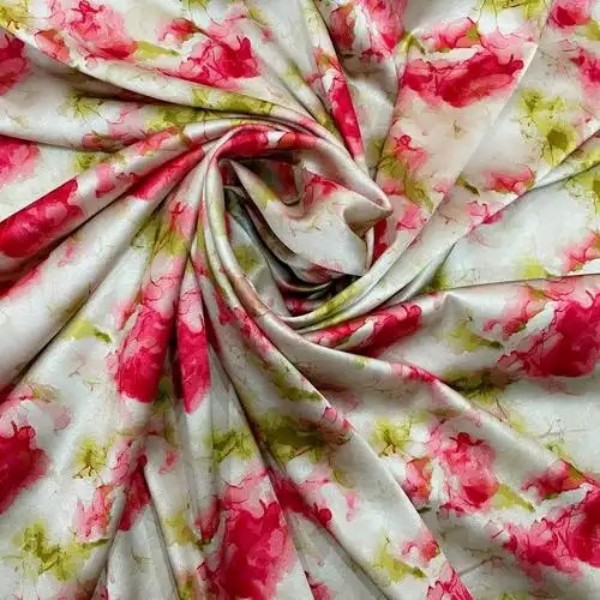
At our company, we take great care to ensure that our woven fabrics have a predictable and manageable shrinkage rate. We offer a wide range of woven fabrics, including TR Printed Woven Fabric, Pure Silk Printed Woven Fabric, and Floral Woven Fabric.
For our cotton - based fabrics, we often pre - shrink them to reduce the shrinkage rate. This means that when you buy our cotton fabrics, you can expect a shrinkage rate of less than 3% under normal washing conditions. Our synthetic - based fabrics, such as those with a high polyester content, have an even lower shrinkage rate, usually less than 1%.
How to Minimize Shrinkage
If you want to minimize the shrinkage of your woven fabric, here are some tips:
- Pre - wash the fabric: Before using the fabric for your project, wash it according to the care instructions. This will remove any excess dyes and chemicals and allow the fabric to shrink before you start sewing.
- Use the right water temperature: Cold water is generally better for reducing shrinkage. Avoid using hot water, especially for natural fibers.
- Air - dry the fabric: Tumble - drying can cause more shrinkage, especially at high temperatures. Air - drying is a gentler option.
Conclusion
The shrinkage rate of woven fabric is an important factor to consider when choosing and using fabric. By understanding the factors that affect shrinkage and how to measure it, you can make more informed decisions. At our company, we're committed to providing high - quality woven fabrics with a low and predictable shrinkage rate. If you're interested in our woven fabrics or have any questions about shrinkage, feel free to reach out to us for a purchase negotiation. We're here to help you find the perfect fabric for your needs.
References
- Textile Institute. "Textile Terms and Definitions." 12th Edition.
- ASTM International. "Standard Test Method for Dimensional Change of Fabrics After Home Laundering." ASTM D3759.